


Grey
A grey turns whiter year after year, whatever colour it was born.
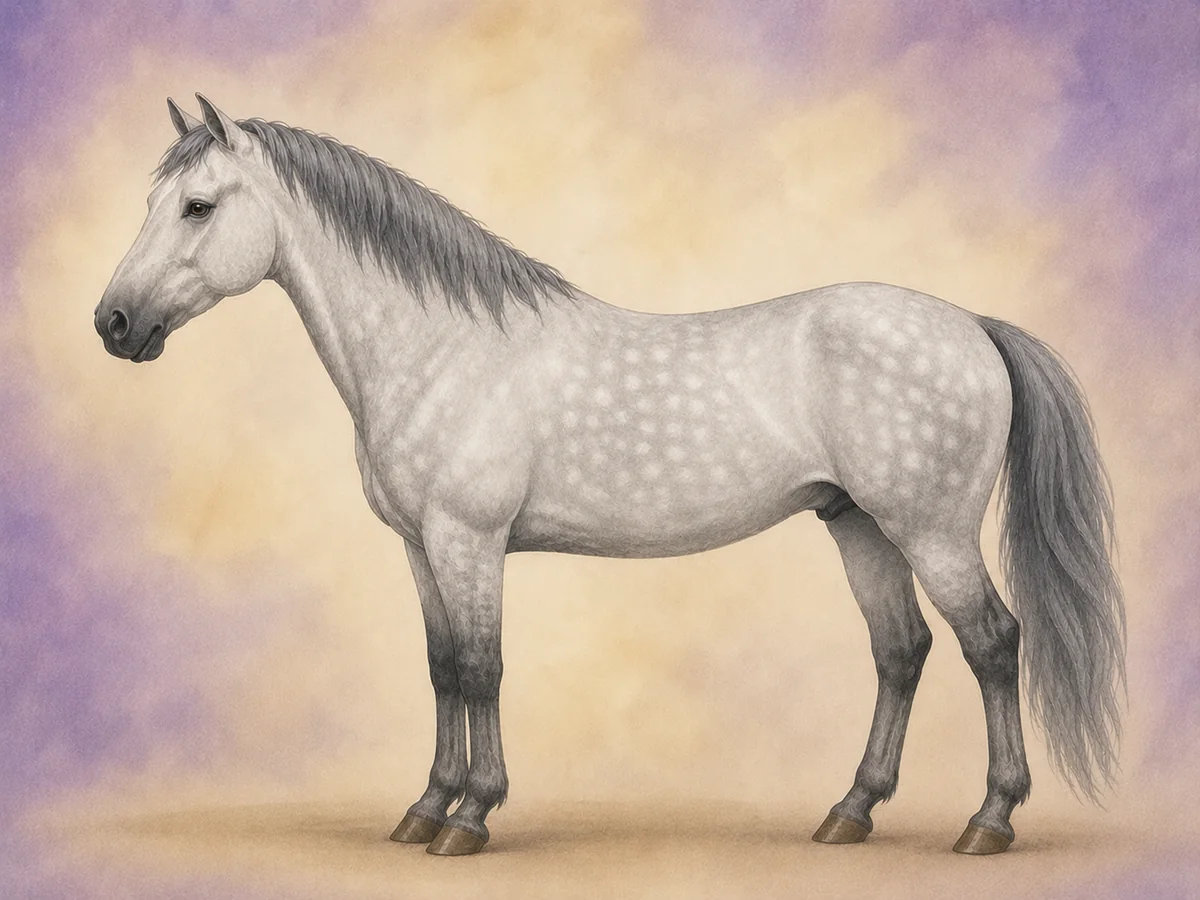
What does this colour look like?
Born in an ordinary base colour, then gradually greying: first grey hairs, often a dappled phase, then flea-bitten flecks, up to almost white. The skin stays dark, the eyes brown.
- Body
- changes from base colour to white
- Mane and tail
- greys along with the coat
- Legs
- grey along with the coat
- Skin
- dark (stays)
- Eyes
- brown
How does this colour arise?
Grey is not a colour but a process: the horse loses its colour year by year and turns white.
More about the genetics
Grey is dominant (G) and causes progressive depigmentation of the hair on any base colour. The skin stays pigmented (dark), which is how a grey differs from a truly white horse. Health note: greys have an increased risk of melanoma.
What is this colour often confused with?
- Roan
In roan, white and coloured hairs mix on the body, while head and legs stay coloured.
- Cremello
An almost white, cream-coloured chestnut with pink skin and blue eyes.
- White
A naturally fully white horse with pink skin, born white (unlike grey).
- Grullo
Dun on a black base: a mouse-grey body with a black dorsal stripe.
Does the colour change?
Key feature: turns whiter year by year.
Which breeds show this colour?
Discover more
Sources: UC Davis Veterinary Genetics Laboratory · Sponenberg, D.P. & Bellone, R.R. (Wiley-Blackwell).