


Lowering the head
Explainer
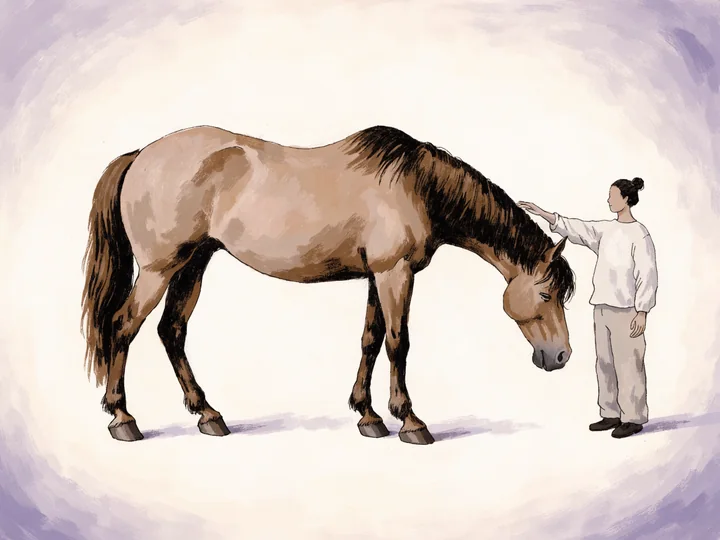
A low head is a posture of relaxation that you can gently encourage, not force.
Goal
Understand why a low-carried head belongs with relaxation and how to encourage that calm.
Before you start
- The horse stands calmly and respects your space
What you need
- Halter and lead rope
The horse's body language
A horse that relaxes lowers its head, chews, sighs and has soft eyes and ears. These are the signs you want to encourage with calm, a soft voice and stroking.
Common mistakes
- Pulling the head down by force
- Forcing the posture instead of encouraging it
- Pushing on when the horse is tense
Safety
- Never force the posture; work with calm and reward.
- Stand beside the head, not directly in front of it.
Stop at once if
- The horse becomes tense or throws its head up
- The horse threatens
Supervision
Recognised learning theory describes a low head as a relaxed posture to encourage, not to force. Teaching a cue for it should be done with an experienced instructor, because you work around the head.
More about this
Research-based learning theory lists lowering the head as an example of a relaxed posture to encourage, along with stroking and a calm voice. It is about helping calm to arise, never about forcing the head down.
Discover more
Sources: International Society for Equitation Science. This page has had a safety review. Descriptive and safety-conscious; not a substitute for guidance from an experienced instructor.