


Leading a horse
Step-by-step
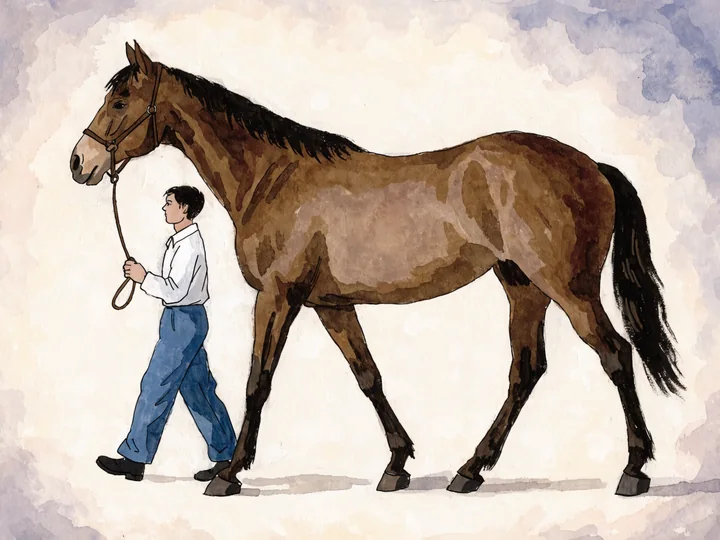
Walk beside the shoulder with a little slack, never wrapping the rope around your hand.
Goal
Lead the horse calmly in hand, with control and without risk to your feet or hands.
Before you start
- Halter correctly fitted
- The horse lets itself be approached calmly and stands still
What you need
- Halter and lead rope
- Gloves
- Sturdy closed shoes
Step by step
- Stand on the left side, between head and shoulder, not ahead and not behind.
- Hold the rope about a hand's width below the clip, with a little slack.
- Fold the loose end into a figure-of-eight in your other hand; never wrap it around hand or wrist.
- Walk calmly forward and ask the horse to come along with your voice and body.
- When you turn, turn the horse away from you, to the right, so it does not step on you.
The horse's body language
Watch the ears and the stride: walking along with soft ears is good. Lagging behind, barging ahead or throwing the head up calls for calm re-balancing, not pulling.
Common mistakes
- Wrapping the rope around hand or wrist
- Walking ahead of the horse and dragging it along
- Turning the horse towards you when changing direction
Safety
- Never wrap the rope around your hand, wrist or body; if the horse spooks you can be dragged.
- Wear gloves against rope burn and closed shoes against trodden feet.
- Walk beside the shoulder to stay out of the kick zone and keep the horse in view.
Stop at once if
- The horse pulls back hard, rears or breaks loose
- The horse swings its hindquarters towards you
Supervision
If the horse pulls back or rears, let go rather than fight for the head, and get an experienced person. Young riders should lead only calm horses under supervision.
More about this
The safest place is beside the shoulder: the horse can see you, you stay out of the kick zone and you can steer along. A little slack keeps things calm; pulling tight invites the horse to pull back.
Discover more
Sources: Extension Horses (Univ. of Arkansas) · British Horse Society · Penn State Extension. This page has had a safety review. Descriptive and safety-conscious; not a substitute for guidance from an experienced instructor.