


Lunging basics
Explainer
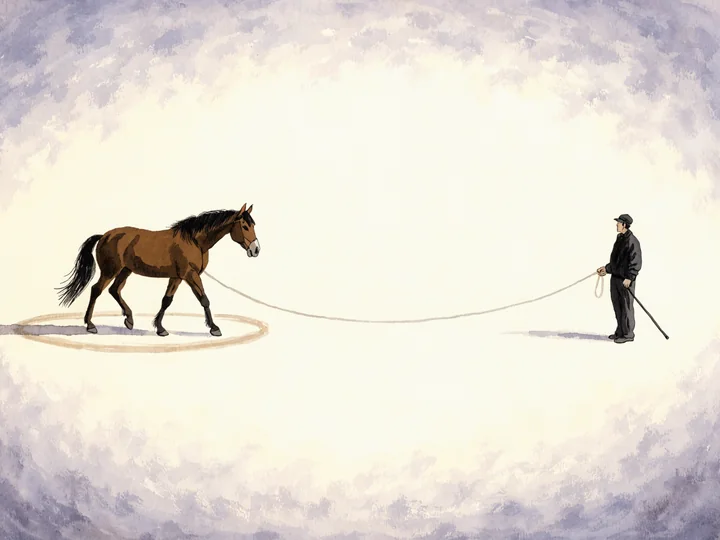
Lunging is working the horse on a circle around a stationary handler on a long line.
Goal
Understand what lunging is, what it is for and what equipment it uses, as a basis for safe, supervised practice.
Before you start
- The horse leads, halts and moves away from you
- A suitable enclosed or fenced area with good footing
What you need
- Lunging cavesson or halter
- Lunge line
- Lunge whip as an extension of your arm
- Gloves, sturdy boots and a hat
The horse's body language
A calm, regular-moving horse paying attention to you is the aim. Rushing, hanging on the line or unrest are signs to step back to calmer work or to stop.
Common mistakes
- Starting without a lesson or supervision
- Too little space or poor footing
- Using the whip as punishment instead of as an aid
Safety
- Wear gloves, sturdy boots and a hat.
- Work in a fenced area with good, non-slip footing.
- The whip is an extension of your arm to give direction, never to punish.
Stop at once if
- The horse panics, strikes out or breaks loose
- You lose control of the line or whip
Supervision
Recognised bodies teach lunging as a built-up skill you learn under a qualified instructor, first practised without a horse. Young riders should lunge only under supervision.
More about this
In lunging the horse moves on a circle around you while you stay more or less in one place and form a triangle: the line to the head, the whip to the hindquarters and the horse as the base. It is used for exercise, loosening, balance and building trust, among other things. It is a skill you should learn under supervision.
Discover more
Sources: British Horse Society · United States Dressage Federation · The Pony Club (UK). This page has had a safety review. Descriptive and safety-conscious; not a substitute for guidance from an experienced instructor.