


Herd behaviour
Horses are herd animals with fixed bonds and roles. Much behaviour only makes sense in the context of the group.
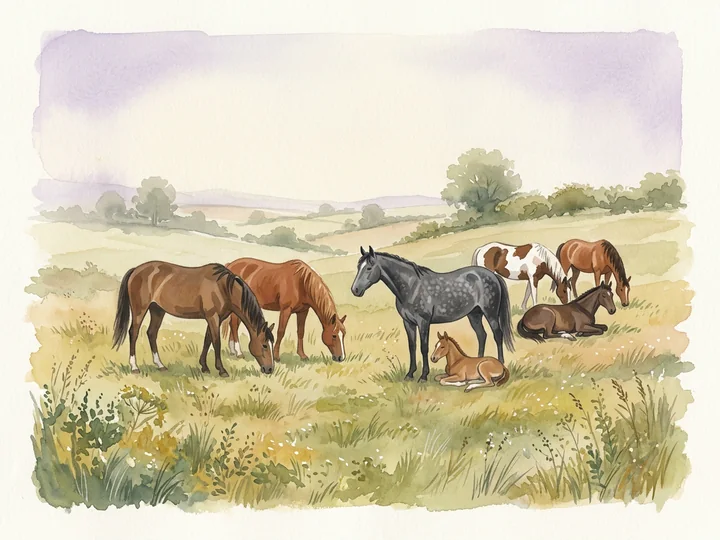
What you see
Horses move, graze and rest together, keep track of each other's distance and direction, and show preferred partners and mutual rank.
What it can mean
- Safety: being together and taking turns to watch makes the group more alert to danger.
- Social bonds with preferred partners, visible in grazing and grooming together.
- Rank and space negotiation, usually through subtle signals rather than fights.
- Unrest or separation from the group often causes stress, calling and searching.
What this does not prove
Rank in the herd does not prove there is a simple linear boss; relationships are nuanced and depend on the context. Judging one horse's behaviour without the group can mislead.
Read the combination and the context
Look at who stands with whom, who grooms with whom and how space is asked for and given. Always judge an individual's behaviour together with the situation in the group.
When to seek help
Persistent, severe stress at separation or unrest in a group should be addressed with attention to housing, company and welfare, with an expert if needed.
Discover more
Sources: McDonnell, S. (2003), University of Pennsylvania School of Veterinary Medicine (New Bolton Center) · McGreevy, P. (2012), Saunders/Elsevier.