


Mutual grooming
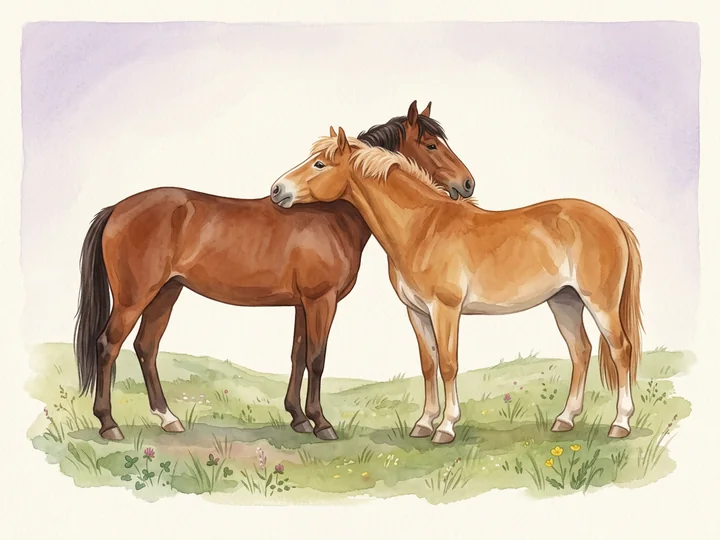
Two horses nibble each other over the neck and withers. This strengthens the bond and measurably lowers the heart rate.
Read the combination and the context. Always read this signal together with the rest of the body and the situation.
What you see
Two horses stand side by side, often head to tail, and nibble each other over the neck, withers and back.
What it can mean
- Maintaining and strengthening social bonds between herd mates.
- Mutual grooming of spots a horse cannot reach well itself.
- A calming effect: grooming at the preferred site on the lower neck measurably lowers the heart rate.
What this does not prove
Mutual grooming is normal, healthy behaviour. Its absence does not immediately prove a problem, but horses do need the company of their own kind to be able to do it.
Read the combination and the context
Note which horses a horse prefers to groom with; that shows preferred partners in the herd. If a horse that used to groom withdraws, watch its health and welfare.
Discover more
Sources: Feh, C. & de Mazieres, J. (1993), Animal Behaviour · McDonnell, S. (2003), University of Pennsylvania School of Veterinary Medicine (New Bolton Center).