


Dun
You recognise a dun by the dorsal stripe along the back and the primitive markings.
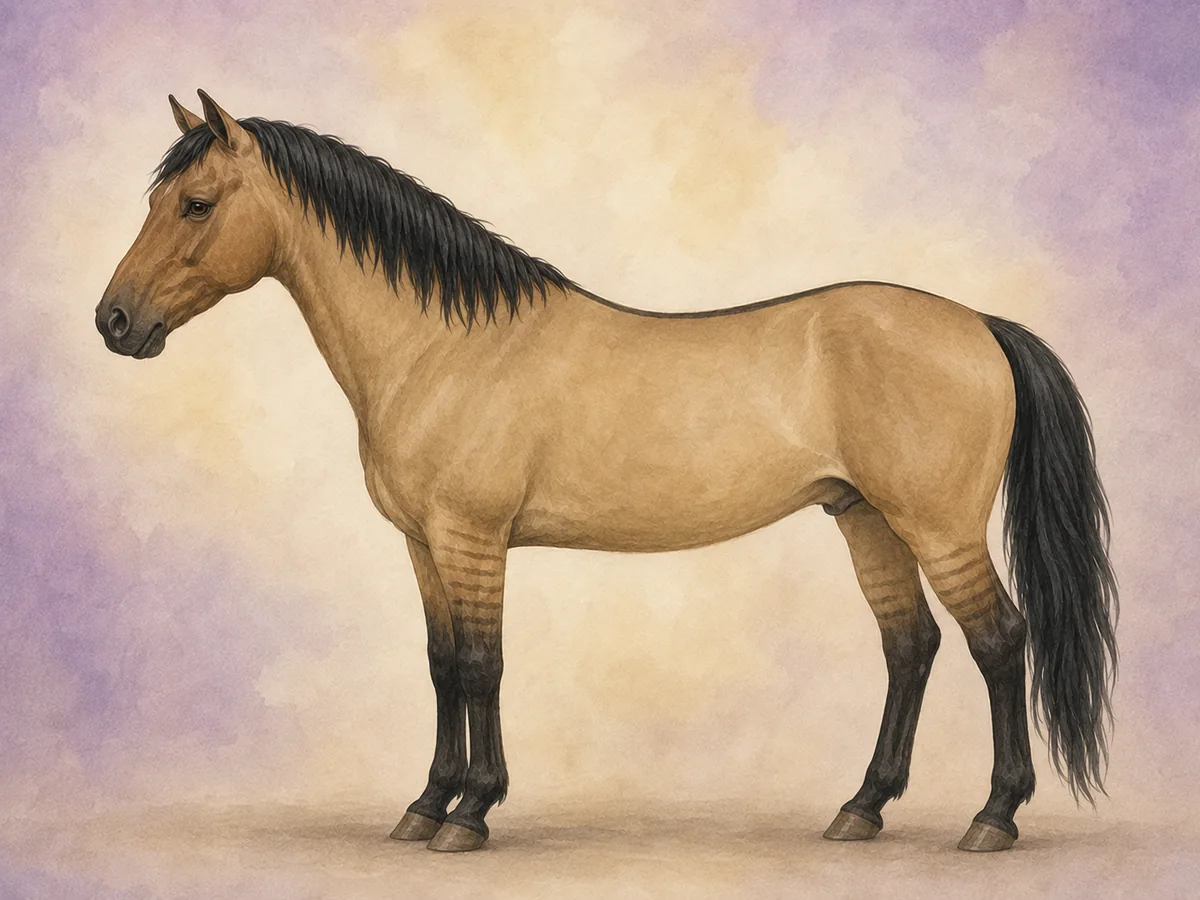
What does this colour look like?
A diluted body (yellowish-brown, reddish or greyish) with a clear dark dorsal stripe along the back, often zebra bars on the legs and shoulder stripes. Head and lower legs stay darker.
- Body
- diluted yellowish-brown / greyish
- Mane and tail
- dark, undiluted
- Legs
- dark, sometimes with zebra bars
- Skin
- dark
- Eyes
- brown
- Primitive markings
- Yes (incl. dorsal stripe)
How does this colour arise?
Dun lightens the body but leaves a dark stripe along the back and bars on the legs.
More about the genetics
Dun is dominant (D). It dilutes both red and black body pigment and leaves head, lower legs, mane and tail undiluted, with the primitive markings as its signature. The two recessive non-dun alleles differ: nd1 horses are not dun-diluted but may show faint primitive marks; nd2/nd2 horses have neither dilution nor primitive marks.
What is this colour often confused with?
- Buckskin
A buckskin has a golden body with black mane, tail and lower legs.
- Grullo
Dun on a black base: a mouse-grey body with a black dorsal stripe.
- Red dun
Dun on a chestnut base: a peach-coloured body with a red-brown dorsal stripe.
- Bay dun
Dun on a bay base: a yellowish-brown body, black points and a dorsal stripe.
Which breeds show this colour?
Discover more
Sources: UC Davis Veterinary Genetics Laboratory · UC Davis Veterinary Genetics Laboratory · Sponenberg, D.P. & Bellone, R.R. (Wiley-Blackwell).