


Approaching a horse
Step-by-step
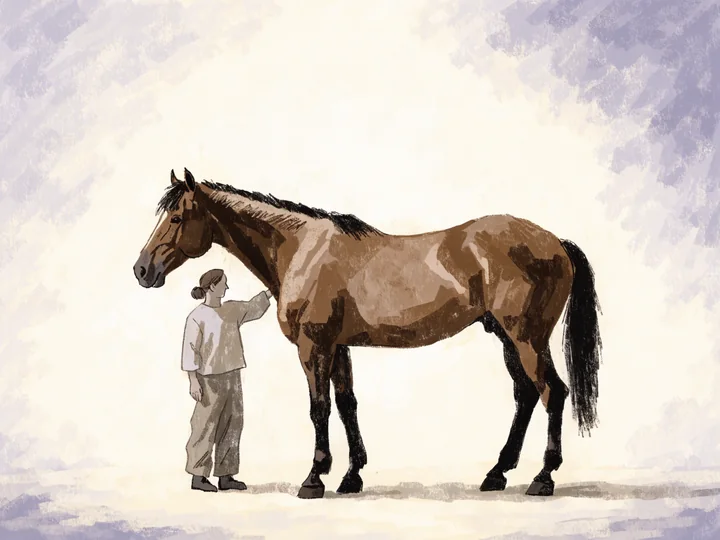
Walk calmly and visibly towards the horse's shoulder so it hears and sees you coming.
Goal
Reach the horse without startling it, and without standing in the blind spots directly in front of or directly behind it.
Before you start
- A calm, familiar horse
- An adult or experienced helper nearby
What you need
- Sturdy closed shoes
- Halter and lead rope ready in hand
Step by step
- Speak or make a soft sound so the horse knows you are coming.
- Walk calmly towards the left shoulder, at an angle from the front, not straight at the head.
- Stay out of the two blind spots: directly in front of the nose and directly behind the hindquarters.
- Rest your hand quietly on the shoulder or neck as first contact.
- Wait a moment until the horse is relaxed before you continue.
The horse's body language
A relaxed horse has a low head, soft eyes and loose ears that turn towards you. A high, tense head, flat ears or turning away are signs to stop and be calmer.
Common mistakes
- Approaching straight at the head or from behind
- Sneaking up too fast or in silence
- Surprising the horse with a pat on the nose
Safety
- Never approach directly from the front or directly from behind; the horse cannot see you there.
- Stay out of the kick and strike zones (the hind legs and directly in front of the shoulders).
- Make yourself heard before you touch the horse.
Stop at once if
- The horse turns its hindquarters towards you or threatens to kick
- The horse is tense, spooky or unsettled
Supervision
Young riders should approach only calm, familiar horses and always with an adult or experienced helper present.
More about this
A horse cannot see just in front of its nose or directly behind itself. From the side, towards the shoulder, you are easiest to see and hear. Calm, predictable movement helps the horse trust you.
Discover more
Sources: Extension Horses (Univ. of Arkansas) · Iowa State University, CFSPH · International Society for Equitation Science. This page has had a safety review. Descriptive and safety-conscious; not a substitute for guidance from an experienced instructor.