


Pawing
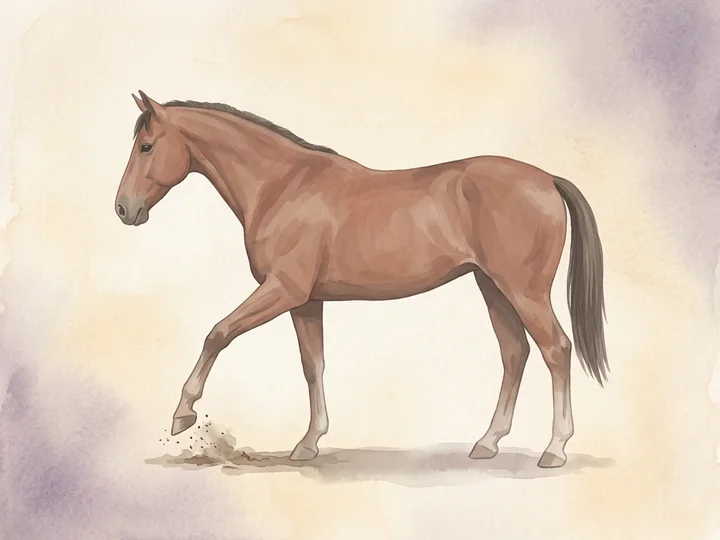
The horse scrapes a foreleg over the ground. Often impatience or frustration, sometimes a sign of belly pain.
What you see
The horse repeatedly draws a foreleg back over the ground, sometimes leaving a scraped hollow.
What it can mean
- Impatience or anticipation, for example before feeding or while waiting.
- Frustration or conflict, when the horse wants something it cannot have.
- Boredom or a learned stable habit.
- Belly pain: horses often paw with colic, usually together with other signs.
What this does not prove
Pawing does not prove disobedience by itself, and it does not prove colic. It only gains meaning through the context and the other signals around it.
Read the combination and the context
At feeding or while waiting, on an otherwise normal, alert horse, pawing usually means impatience. Pawing together with looking round at the belly, lying down and getting up, rolling, sweating or not eating can point to colic.
When to seek help
Pawing together with signs of belly pain, such as looking round at the flank, repeatedly lying down, rolling, not eating or sweating, is a reason to call a vet at once.
Discover more
Sources: McDonnell, S. (2003), University of Pennsylvania School of Veterinary Medicine (New Bolton Center) · World Horse Welfare.