


Rolling
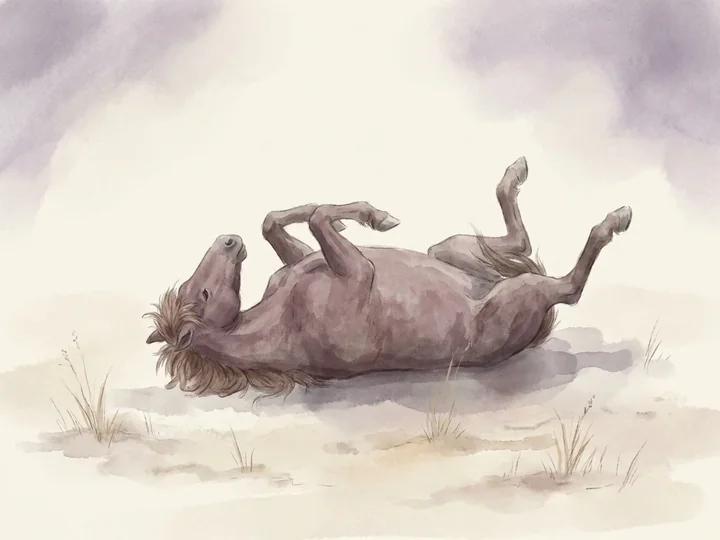
The horse lies down and rolls over its back. Usually normal comfort behaviour, but violent repeated rolling can be colic.
What you see
The horse lies down, rolls over its back from one side to the other and often gets up afterward to shake itself.
What it can mean
- Normal comfort and grooming behaviour: relieving itch, caring for the coat and feeling good.
- After being turned out to pasture or after sweating, often followed by a shake.
- Repeated, violent going down and rolling without shaking can be a sign of belly pain.
What this does not prove
Rolling does not prove colic by itself, nor a problem; it is usually just pleasant behaviour. It is the manner of rolling and the whole picture around it that give meaning.
Read the combination and the context
Compare relaxed rolling followed by shaking and grazing with repeated, tense going down and rolling without eating, together with looking round at the belly, pawing or sweating.
When to seek help
Repeated, violent rolling together with other colic signs, such as looking round at the flank, not eating, sweating or restlessness, is a reason to call a vet at once.
Discover more
Sources: McDonnell, S. (2003), University of Pennsylvania School of Veterinary Medicine (New Bolton Center) · World Horse Welfare.