


Rest and sleep
Horses doze standing and sleep in short bouts. For real deep sleep they must lie down flat now and then.
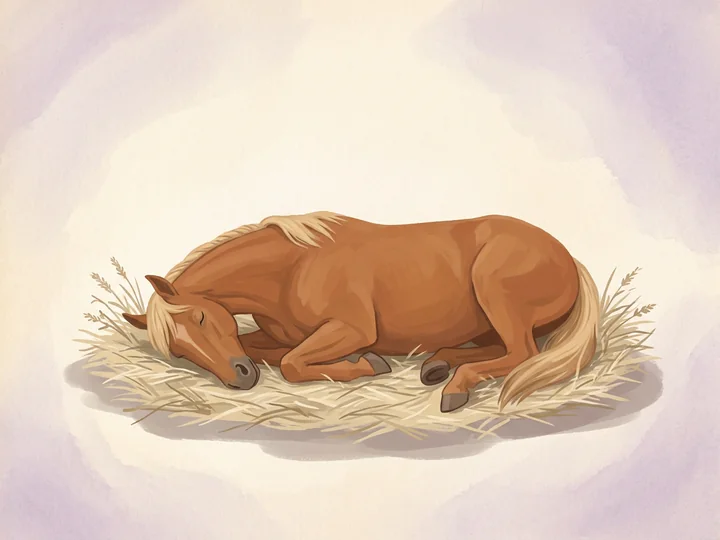
What you see
The horse dozes standing with a low head, a resting leg and half-closed eyes, or lies sternal or flat on its side. Sleep comes in short bouts spread over the day and night.
What it can mean
- Standing dozing and light sleep thanks to the stay apparatus, which locks the legs with almost no muscle effort.
- Deeper sleep lying sternal, with the legs tucked under the body.
- REM sleep, in which the muscles relax fully, is only possible lying flat, so a horse must lie down properly for it now and then.
What this does not prove
A lying horse is not automatically ill; lying flat belongs with normal sleep. But being able to doze standing does not prove a horse gets enough deep sleep, because for that it must be able to lie down.
Read the combination and the context
Note whether a horse can lie down safely: enough space, a dry soft surface and calm in the group. Horses that never lie down can become sleep deprived and sometimes suddenly buckle.
When to seek help
A horse that no longer lies down at all, is strikingly dull or unexpectedly buckles at the forelegs should be assessed by a vet for pain, sleep deprivation or other causes.
Discover more
Sources: University of California, Davis, School of Veterinary Medicine · McDonnell, S. (2003), University of Pennsylvania School of Veterinary Medicine (New Bolton Center).