


Body condition and Body Condition Score
The Body Condition Score (BCS) is a way to judge whether a horse is too thin, ideal or too fat, by looking and feeling at fixed points on the body.
General information, not individual feeding or ration advice. For your own horse, consult your vet or a nutritionist.
How does it work?
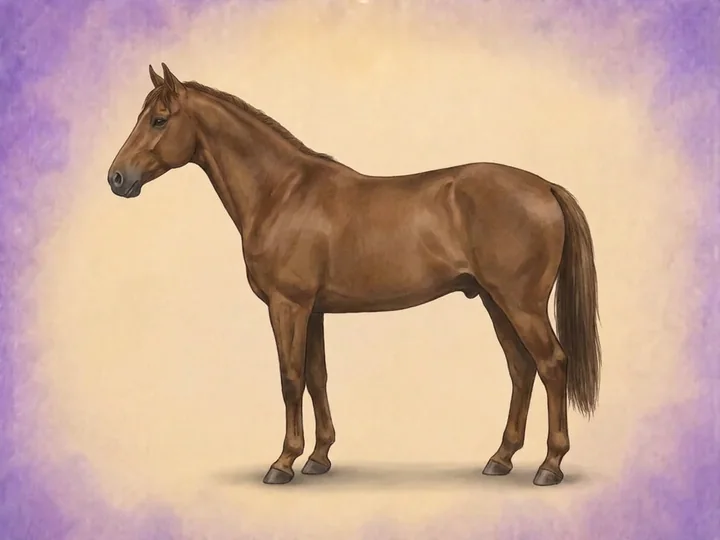
The most widely used scale is the Henneke scale, which runs from 1 (emaciated) to 9 (extremely fat), with an ideal around 5 and a healthy range of about 4 to 6, depending on breed and use. You assess with both the eye and the hand at six points: neck, withers, shoulder, ribs, loin and tailhead. There is also a British scale from 0 to 5, so a score of '3' may refer to a different scale than a '5'.
Why it matters
Bodyweight alone tells you little; the condition score shows whether the ration suits the horse. Scoring regularly helps you spot weight gain or weight loss early.
Common misconceptions
- A fat horse is not 'in good condition'; being overweight is a health risk.
- The ribs may be lightly palpable on a horse in ideal condition; they do not need to be visible, nor covered in fat.
What to watch for
Ongoing overweight increases, among other things, the risk of laminitis and metabolic problems. Use the condition score as a general tool and, if in doubt or if there are rapid changes, talk to your vet.
Discover more
Sources: UF/IFAS Extension.